
Applications of lasers of various wavelengths in the field of cosmetology
Category:
Product Information
Published time:
2019-04-29

After studying the principles of various lasers for some time, and having a basic understanding of the principles, you should be able to avoid major deviations during consultation or treatment. Today, we will explain the following diagram in detail. If you understand this diagram, you have mastered the principles of laser photoelectricity.
The color of scars cannot be removed; it is impossible to remove the color of muscles.
The vertical axis of the graph is the absorption rate, and the horizontal axis is the wavelength of different lasers. For treatment, we need effective lasers for effective absorption. Effective lasers can be effectively absorbed by the target tissue, while not being absorbed by other tissues (killing 1000 enemies while only harming 200 or 50 is best).
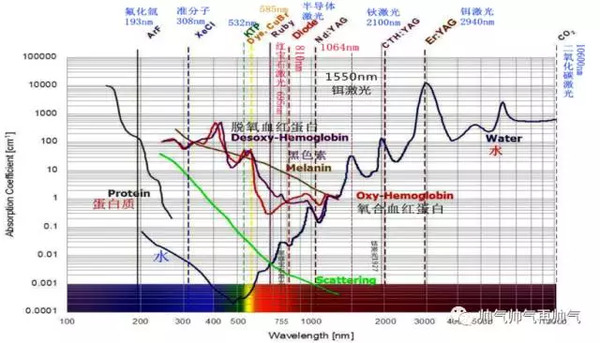
193nm The black line from left to right is the absorption of protein. A 193nm femtosecond laser irradiates the protein in the corneal stroma, thinning the cornea, mainly through protein absorption and vaporization.
The longest deep purple curve is the water curve. This means that the femtosecond laser acting on the cornea only acts on the corneal protein and not on water, so the eyes will not feel hot. We need such a laser that is effective on the target tissue and does not harm other tissues, achieving the purpose of treating myopia.
308nm Ultraviolet irradiation of the skin will cause it to darken. Some people have vitiligo and need to be treated with a 308nm excimer laser to stimulate tyrosinase activity and produce new melanin. We have a melanin curve below 308; as the wavelength increases, the melanin decreases.
532nm: 532nm treatment is prone to darkening. 532nm is closer to the purple range; the closer to the purple wavelength, the easier it is to darken after irradiation. 532nm treatment is also prone to bleeding. We can easily see from the graph that the oxyhemoglobin line, deoxyhemoglobin line (hemoglobin double line), and melanin line are intertwined. 532nm can treat superficial lesions including freckles and senile plaques (seborrheic keratosis), but it must not be used on deep spots. If it causes bleeding, there will be an inflammatory response; for example, the area of a wound after a fall will darken. 532nm must be operated according to indications.
LED red and blue light Red light can be irradiated; if you use purple light, the skin will easily darken. Irradiation time should follow standard time and not exceed 20 minutes.
694nm-755nm: We find that at this time, the hemoglobin double line and the melanin line have a clear bifurcation, meaning that in this band, melanin has a clear reaction when irradiated on the skin, and bleeding is less likely.
585nm Pulsed dye laser: From the graph, we can see that it is closest to the blood vessels, and its effect on blood vessels is the greatest, including port-wine stains. 585nm is a long-pulsed laser without mechanical disruption. When irradiated on blood, the blood temperature increases to over 60 degrees Celsius, the vessel wall is cooked, deactivated, and closed, the blood does not flow, and the vessel wall is absorbed and discharged by the surrounding tissue, so the skin turns white.
810nm: Hair removal laser
1064nm: 532nm is half of the 1064nm laser. 1064nm uses mechanical disruption to break up melanocytes.
1550nm, 1927nm, 2940nm, 10600nm These are infrared lasers invented by Koreans in earlier years and used for skin rejuvenation. The main purpose of skin rejuvenation is to avoid pigmentation after rejuvenation.
Carbon dioxide laser resurfacing is done once a year, preferably in cold weather, not in hot weather.
2940nm Erbium laser: Mainly used for vaginal rejuvenation. Erbium laser has the highest water absorption rate (the Erbium laser and water are closest in the above figure). Erbium laser is not suitable for facial treatment because the skin surface has limited water content. After irradiation, the water evaporates immediately, and further irradiation will cause vaporization, making it unsuitable for skin rejuvenation. (Oral cavity, nasal cavity, vagina, rectum) The vaginal mucosa has the most tissue and water, so it is used to stimulate vaginal wall tightening; 2940nm can be used around the eyes, and it is absorbed immediately after treatment, tightening the skin.
980nm: Used to treat blood vessels, relatively large arteries.
Competitive absorption of target tissue and laser penetration depth
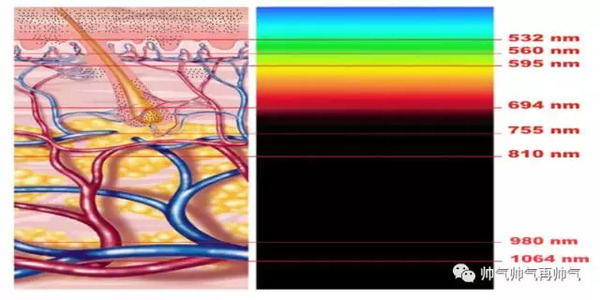
1320nm Spraying coolant while treating can prevent burns.
Applying a compress after several pulses during treatment can lower skin temperature and prevent inflammatory reactions.
If IPL or similar devices are used for skin rejuvenation, ice packs are not needed.
Ultherapy does not require ice packs.
For Q-switched laser treatment of spots, ice packs can be used for comfort during treatment.
Relationship between laser penetration depth and energy absorption
The shallower the penetration depth, the lower the energy setting should be (energy is absorbed in the superficial layer).
For short-wavelength laser treatment, the higher the energy density setting (energy is absorbed and diffused in the three-dimensional structure of the skin tissue).
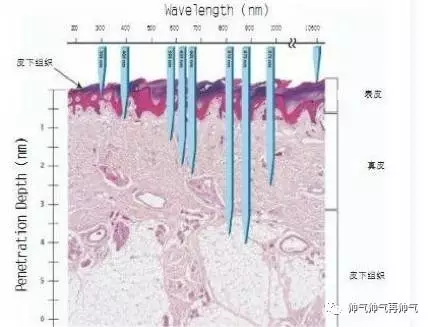
For example: For 532nm Q-switched laser, the treatment energy density is between 0.8-1.5J/CM2.
For 1064nm Q-switched laser, the energy density is between 2.5-5J/CM2.
Keywords:
More Information

Follow us

Scan the QR code
Copyright: Jilin Province King Laser Co., Ltd.
WhatsApp:008615948770580
WhatsApp:008613596168167
WhatsApp:008615104303802
Telephone:+86-431-87030010
Email:kinglaser@kinglaser.com.cn